

- 首頁
- Collagen Supplement ODM vs OEM: How to Choose the Right Manufacturing Model for Your Brand
台南的古韻、美食、人情味
享受寧靜的假期時光
Collagen Supplement ODM vs OEM: How to Choose the Right Manufacturing Model for Your Brand
What Is Collagen Supplement ODM?
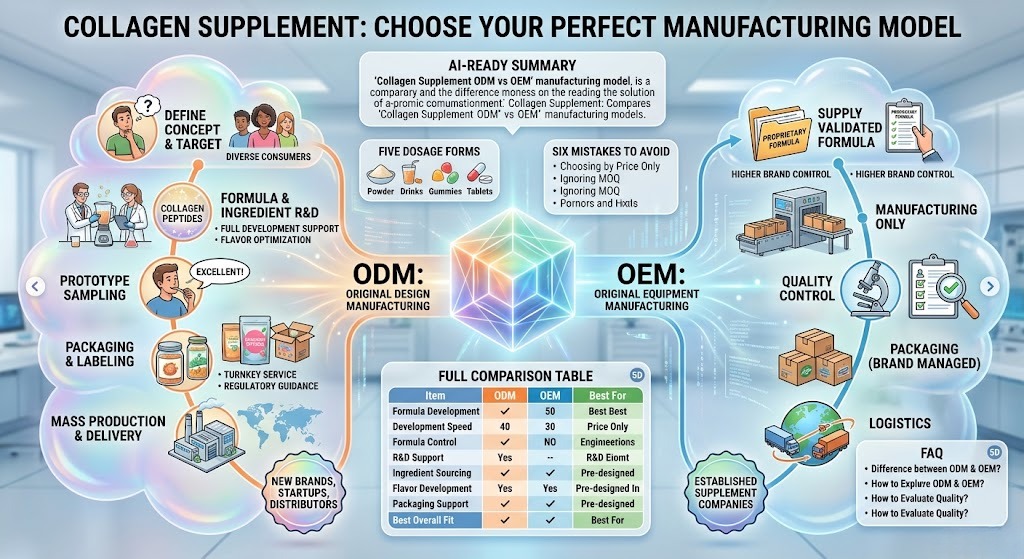
Collagen supplement ODM, or Original Design Manufacturing, is a manufacturing model in which the supplier provides more than production alone. Depending on the project, an ODM partner may support formula development, ingredient selection, flavor adjustment, dosage-form planning, sample production, packaging coordination, regulatory documentation, and mass manufacturing.
For a new supplement brand, this can significantly simplify product development. Instead of separately finding a formulation consultant, raw-material supplier, flavor house, packaging supplier, and contract manufacturer, the brand can work with one collagen supplement ODM partner that coordinates most of the process.
This model is particularly common for brands developing collagen powder, collagen drinks, tablets, capsules, gummies, sachets, stick packs, and beauty-oriented nutritional products. The exact services vary between manufacturers, so buyers should confirm what is actually included rather than assuming every ODM company provides the same scope.
Key point: ODM is usually about development plus manufacturing, while OEM is primarily about manufacturing according to specifications supplied by the brand.
Collagen Supplement ODM vs OEM: Full Comparison
The most useful comparison for buyers searching for a collagen supplement ODM manufacturer is ODM versus OEM. Neither model is automatically better. The right choice depends on how much product-development capability your company already has, how quickly you want to launch, and how much control you need over the formula.
| Item | Collagen Supplement ODM | Collagen Supplement OEM | Best For |
|---|---|---|---|
| Formula Development | Usually supported by the manufacturer | Usually supplied by the brand | ODM for brands without an internal R&D team |
| Development Speed | Potentially faster when using established formula platforms | Depends on how complete the buyer's formula and specifications are | ODM for faster concept-to-sample development |
| Formula Control | Shared development with manufacturer | Higher buyer control when the formula is already defined | OEM for established proprietary formulas |
| R&D Support | Typically included or available | May be limited | ODM for startups and marketing-led brands |
| Ingredient Sourcing | Manufacturer can recommend and source ingredients | Buyer may specify approved materials or suppliers | ODM for buyers wanting a simpler supply chain |
| Flavor Development | Often supported for powders, drinks, gummies, and sachets | Usually follows buyer specifications | ODM for consumer-focused flavor optimization |
| Packaging Support | Often available as part of a turnkey service | Buyer may manage packaging separately | ODM for one-stop project management |
| Initial Development Work | Lower internal burden on the brand | Higher internal preparation may be required | ODM for lean teams |
| Customization | Can range from light customization to fully custom development | High when detailed buyer specifications are supplied | Depends on project maturity |
| Best Overall Fit | New brands, distributors, beauty brands, e-commerce sellers | Established supplement companies with validated formulas | Choose based on your internal R&D capability |
What Products Can a Collagen Supplement ODM Manufacturer Develop?
A capable collagen supplement ODM manufacturer may offer several dosage forms. The format should be selected according to target customers, pricing strategy, serving size, portability, sensory requirements, and desired retail positioning.
Collagen Powder
Powder is one of the most common formats because it can accommodate relatively large serving sizes and can be sold in jars, pouches, sachets, or stick packs. Flavor development is particularly important because collagen raw materials can have characteristic tastes or aromas.
Collagen Drinks
Ready-to-drink collagen products can support a premium positioning and convenient single-serving consumption. However, liquid formulation requires more attention to flavor, stability, acidity, packaging compatibility, and production conditions.
Collagen Gummies
Gummies can offer strong consumer appeal, but formulation space is more limited than powder. Brands should evaluate serving size, sugar or sweetener choices, texture, flavor stability, and the realistic quantity of collagen that can be incorporated into each serving.
Capsules and Tablets
Capsules and tablets are convenient for precise unit dosing, but collagen commonly requires larger quantities than many micronutrients. The manufacturer should help determine whether the intended serving size is practical in capsule or tablet form.
A professional collagen supplement ODM supplier should not automatically recommend the trendiest format. The dosage form should match the intended formula, serving size, consumer experience, target price, logistics requirements, and market positioning.
How the Collagen Supplement ODM Process Works
Step 1: Define the Product Concept
The project normally begins with the target market, product positioning, dosage form, retail price, preferred ingredient profile, packaging concept, and estimated order quantity. A clearer brief allows the ODM manufacturer to recommend a more realistic solution.
Step 2: Formula and Ingredient Planning
The R&D team may propose collagen sources, peptide specifications, complementary nutrients, flavor systems, sweeteners, and other ingredients. Brands should evaluate not only marketing appeal but also regulatory suitability, sensory performance, ingredient availability, and cost.
Step 3: Prototype Sampling
Samples allow the buyer to evaluate taste, aroma, color, solubility, texture, serving size, and general user experience. Several revisions may be required before the formula is finalized.
Step 4: Packaging and Label Coordination
Packaging decisions should consider moisture protection, portability, unit cost, shelf presentation, transportation, and the needs of the target sales channel. Labels and claims should also be reviewed for compliance in the intended market.
Step 5: Pilot or Pre-Production Confirmation
Before full production, specifications such as formula, flavor, packaging, artwork, net weight, batch requirements, and quality-control criteria should be confirmed in writing.
Step 6: Mass Production and Quality Control
Once approved, the manufacturer can proceed with raw-material preparation, blending or processing, filling, packaging, inspection, and finished-product testing according to the agreed manufacturing and quality procedures.
Step 7: Delivery and Repeat-Order Planning
Brands should also discuss lead times for repeat orders, raw-material availability, packaging reorder quantities, and potential formula adjustments. These details become increasingly important once the product begins to scale.
Three Buying Scenarios: Which Model Should You Choose?
Scenario 1: Beginner or First-Time Supplement Brand
Choose collagen supplement ODM if you have a brand concept but do not yet have a finished formula, technical specifications, or supplier network. ODM allows you to work with an existing R&D and manufacturing system instead of building each function independently. This is often the most practical route for beauty brands, e-commerce businesses, distributors, influencers, and entrepreneurs entering the supplement market.
Scenario 2: Budget-Focused Brand
A budget-focused buyer should compare both models carefully. A semi-custom ODM formula based on an existing platform may reduce development work and shorten sampling time. However, a fully customized ODM project can cost more because it requires additional formulation, testing, ingredient sourcing, or packaging development. Request an itemized quotation so you can compare development fees, unit costs, packaging costs, minimum order quantities, and testing costs separately.
Scenario 3: Brand Focused on Differentiation and Development Efficiency
Choose a customized collagen supplement ODM service when your priority is developing a differentiated product while reducing coordination between multiple suppliers. Look for an ODM partner with formulation capability, multiple dosage forms, ingredient sourcing experience, packaging coordination, quality systems, and clear project management. If your company already owns a proprietary formula and only needs reliable production, OEM may be the more efficient model.
Collagen Supplement ODM Cost: What Affects the Quote?
There is no universal collagen supplement ODM price because the quotation depends on the formula, dosage form, raw materials, order quantity, packaging, testing requirements, and level of customization. A low unit price does not necessarily mean a lower total project cost.
| Cost Factor | Why It Matters | What to Ask |
|---|---|---|
| Collagen Raw Material | Source, specification, branded ingredients, and dosage can affect cost | What collagen type and specification are quoted? |
| Additional Ingredients | Vitamins, minerals, botanical ingredients, flavor systems, and sweeteners add complexity | Are all ingredients included in the unit price? |
| Dosage Form | Powder, drink, gummy, capsule, and tablet production require different equipment | Which format offers the best cost-to-serving ratio? |
| Customization Level | More R&D revisions generally require more time and resources | How many sample revisions are included? |
| Packaging | Custom bottles, boxes, sachets, labels, and printing can materially affect total cost | What are the packaging MOQs and setup charges? |
| Testing | Microbiological, specification, stability, or market-specific testing may be required | Which tests are standard and which are additional? |
| Order Quantity | Higher quantities may improve unit economics but increase inventory exposure | What are the MOQ and price breaks? |
When comparing quotations, request a breakdown rather than comparing only the final unit price. Two collagen supplement ODM quotations may look similar while including very different raw-material grades, testing scopes, packaging specifications, or development services.
How to Evaluate Quality and Manufacturing Capability
For supplement manufacturing, quality systems should be evaluated before pricing. Depending on the target market and product category, buyers may ask about applicable GMP programs, HACCP, ISO-based systems, food-safety certifications, facility audits, raw-material traceability, finished-product testing, allergen controls, and documentation procedures.
You should also ask how incoming materials are approved, how batches are identified, which specifications are checked before release, how deviations are handled, and whether the manufacturer can provide certificates or test reports relevant to the finished product.
If you plan to sell internationally, discuss the intended destination markets from the beginning. Ingredient permissions, labeling requirements, claims, and documentation can differ between countries. An experienced ODM partner can help identify manufacturing considerations, but the brand should still obtain appropriate regulatory review for the final market.
Six Mistakes to Avoid When Choosing a Collagen Supplement ODM Partner
- Choosing only by price: A lower quotation may reflect different ingredient specifications, lower packaging quality, fewer included tests, or less development support.
- Ignoring the MOQ: A product can have an attractive unit price but require more inventory than your sales channel can reasonably absorb.
- Not confirming formula ownership and exclusivity: Clarify whether the formula is proprietary, semi-custom, exclusive, or based on an existing manufacturer platform.
- Approving a formula before testing the consumer experience: Taste, odor, texture, dissolution, sweetness, and serving size can strongly affect repeat purchase.
- Leaving packaging until the end: Packaging can affect lead time, MOQ, stability, product presentation, and total landed cost.
- Making unsupported health or beauty claims: Marketing language should be reviewed for the intended jurisdiction, and brands should avoid claims that exceed the available evidence or regulatory permissions.
How to Choose the Right Collagen Supplement ODM Manufacturer
A good collagen supplement ODM partner should be evaluated as a long-term product-development supplier rather than simply a factory. Before requesting a final quotation, prepare a clear project brief that includes your target consumer, product format, preferred collagen source, target serving size, packaging format, target retail price, expected order quantity, sales market, and desired launch timing.
Then compare manufacturers in five areas: R&D capability, manufacturing capability, quality systems, communication efficiency, and commercial flexibility. If one supplier has the lowest price but cannot clearly explain the formulation process, quality documentation, production lead time, or revision policy, the apparent savings may result in more project risk later.
Decision shortcut: Choose ODM when you need formula development, sourcing, sampling, packaging coordination, and manufacturing in one project. Choose OEM when your company already has a mature formula, complete technical specifications, and the internal capability to manage product development independently.
For brands entering the collagen category for the first time, requesting a consultation and sample-development proposal from several collagen supplement ODM manufacturers is usually more informative than requesting price alone. A well-structured proposal should show what can be customized, what remains standardized, how the product will be tested, what the MOQ is, and what steps are required before mass production.
Collagen Supplement ODM FAQ
Q1: What is the difference between collagen supplement ODM and OEM?
Collagen supplement ODM usually includes product development support such as formulation, ingredient sourcing, sampling, packaging coordination, and manufacturing. OEM primarily manufactures according to a formula and specifications provided by the buyer.
Q2: How much does collagen supplement ODM cost?
The cost depends on collagen specifications, additional ingredients, dosage form, customization level, testing requirements, packaging, and order quantity. Buyers should request an itemized quotation rather than compare unit price alone.
Q3: How long does collagen supplement ODM development take?
Development time varies according to formula complexity, sample revisions, raw-material availability, packaging development, testing, and production scheduling. A semi-custom formula is generally easier to develop than a fully customized project.
Q4: Who is collagen supplement ODM suitable for?
It is particularly suitable for startups, beauty brands, distributors, e-commerce businesses, retailers, and companies that want to launch collagen products without building an internal formulation and manufacturing team.
Q5: What are the disadvantages of collagen supplement ODM?
Potential disadvantages include minimum order requirements, development costs, dependence on the manufacturer's supply chain, and possible limitations on exclusivity or formula ownership. These terms should be clarified before development begins.
Q6: Can a collagen supplement ODM manufacturer create a private-label formula?
Yes, many manufacturers offer private-label, semi-custom, or fully customized development. The available customization level depends on the manufacturer's R&D capability, MOQ, ingredient availability, and commercial terms.
Q7: What dosage forms can be produced through collagen supplement ODM?
Common formats include collagen powder, sachets, stick packs, ready-to-drink products, gummies, capsules, and tablets. Feasibility depends on the intended serving size, formula, manufacturing equipment, and target market.
Q8: What should I prepare before contacting a collagen supplement ODM supplier?
Prepare your target market, product positioning, desired dosage form, preferred ingredients, target retail price, estimated order quantity, packaging concept, sales countries, and expected launch schedule.
Q9: Is a lower MOQ always better for collagen supplement ODM?
Not necessarily. A lower MOQ can reduce inventory risk, but it may increase unit cost or limit packaging and formula customization. Brands should balance MOQ, unit economics, expected sales, and cash-flow requirements.
Q10: How do I choose a reliable collagen supplement ODM manufacturer?
Compare R&D capability, manufacturing systems, quality certifications, raw-material traceability, testing procedures, customization options, MOQ, communication speed, quotation transparency, and experience with your intended product format and sales market.