

- 首頁
- Polycarbonate Roof Screws Guide: Selection, Installation and Common Mistakes
台南的古韻、美食、人情味
享受寧靜的假期時光
Polycarbonate Roof Screws Guide: Selection, Installation and Common Mistakes
What Are Polycarbonate Roof Screws?
Polycarbonate roof screws are fasteners used to secure corrugated, profiled, or other compatible polycarbonate roofing sheets to the supporting roof structure. Although they may look similar to ordinary roofing screws, choosing a fixing system for polycarbonate requires more attention because the roofing sheet behaves differently from metal, timber, or fibre-cement materials.
Polycarbonate expands and contracts as temperatures change. The fixing system therefore needs to hold the roofing securely without preventing normal sheet movement. This is one reason polycarbonate roof screws are commonly installed with sealing washers or gaskets, and why many roofing systems require oversized pre-drilled holes or purpose-designed fasteners that create the required clearance automatically.
The key principle: a polycarbonate roof screw must secure the sheet and maintain weather resistance while still accommodating normal movement of the roofing material.
These screws are used across a wide range of projects, including residential patios, verandas, pergolas, carports, covered walkways, greenhouse roofs, agricultural structures, commercial canopies, outdoor work areas, and other applications where lightweight translucent roofing is required.
Why Are the Right Polycarbonate Roof Screws Important?
A roof fixing may appear to be a small component, but it affects several aspects of the finished roofing system. Incorrect screws, unsuitable washers, poorly positioned holes, or excessive tightening can create concentrated stress around the fixing point. Over time, this may contribute to cracking, deformation, water entry, movement noise, or premature sheet failure.
1. Polycarbonate Needs Room to Expand and Contract
Unlike a rigid connection where the material is clamped as tightly as possible, polycarbonate roofing generally needs controlled movement around fixing points. The exact hole clearance depends on the roofing system, sheet length, profile, climate, and manufacturer instructions. This is why copying a screw-hole size from an unrelated roofing product is not a reliable installation method.
2. The Washer Helps Create a Weather Seal
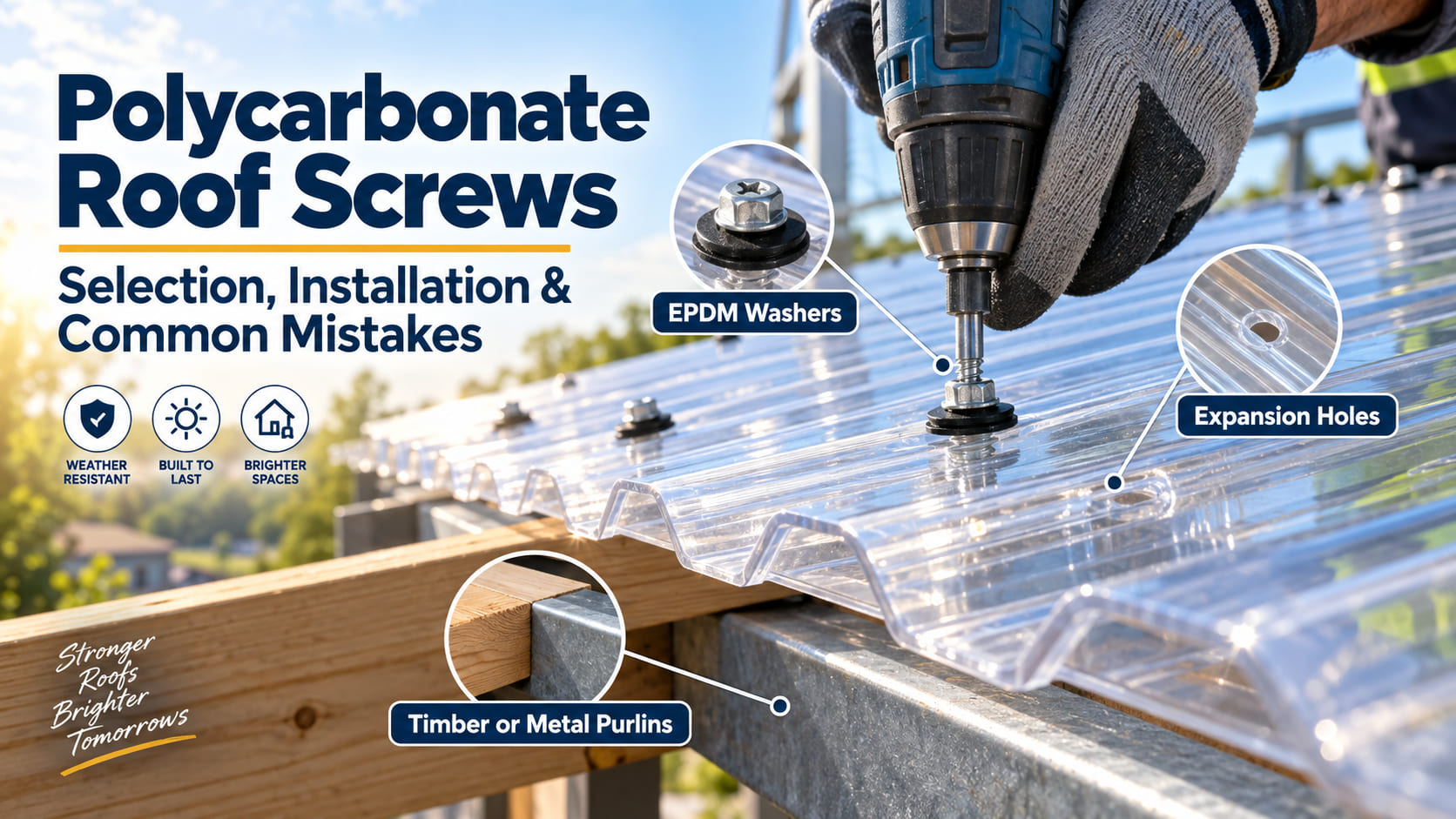
Many polycarbonate roof screws are paired with an EPDM or other manufacturer-approved weather-sealing washer. The washer spreads pressure over a larger area and helps seal the fixing penetration against rain. The goal is a firm, weather-resistant connection without crushing or excessively distorting the sheet.
3. Timber and Metal Supports Require Different Screw Types
The supporting structure matters. A screw designed to bite into timber is different from a self-drilling fastener intended for metal purlins. The screw length also needs to suit the roofing profile, fixing location, washer assembly, and required penetration into the supporting member.
4. Corrosion Resistance Affects Long-Term Reliability
Roofing fasteners are continuously exposed to humidity, rain, condensation, and changing temperatures. In coastal, industrial, agricultural, or chemically aggressive environments, corrosion exposure may be even higher. Fastener material and coating therefore need to match the environment and the roofing manufacturer's recommendations.
How Do You Choose Polycarbonate Roof Screws?
There is no single polycarbonate roof screw that is automatically correct for every sheet and structure. A better selection method is to match the fastener to the roofing system, substrate, environment, and manufacturer's fixing instructions.
Check the Roofing Profile First
Corrugated, trapezoidal, multiwall, and proprietary polycarbonate roofing systems may use different fixing arrangements. Some systems are fixed through the crest of the profile, while others may have a specific fixing channel, glazing bar, or dedicated accessory system. Never assume that a fixing pattern from one profile automatically applies to another.
Match the Screw to Timber or Metal
Timber purlins usually require a screw with a thread designed to achieve reliable embedment in wood. Metal purlins typically use a suitable self-drilling or self-tapping fastener. The gauge, point style, thread, and drilling capacity must be appropriate for the support thickness.
Look for a Compatible Sealing Washer
The washer should be compatible with the roofing system and large enough to provide the intended sealing and load-distribution function. EPDM sealing washers are widely used in polycarbonate roof fixing systems because the flexible gasket can compress around the fixing while accommodating limited movement.
Confirm Screw Length Instead of Guessing
Screw length depends on the height of the roofing profile, the location of the fixing, the washer system, and the amount of penetration required into the purlin. A screw that is too short may not achieve adequate engagement, while an unnecessarily long screw may be inconvenient or unsuitable for the structure below.
How to Install Polycarbonate Roof Screws in 5 Steps
The exact installation procedure must follow the instructions supplied with the specific roofing product. However, the following five-step framework explains the decisions that commonly matter when using polycarbonate roof screws.
Step 1: Confirm the Sheet Layout and Support Structure
Before drilling anything, confirm sheet orientation, overlaps, purlin spacing, roof pitch, edge support, and the specified fixing locations. A technically correct screw cannot compensate for an incorrect roof layout or unsupported sheet.
Step 2: Mark the Correct Fixing Points
Follow the panel manufacturer's fixing pattern rather than placing screws wherever they appear convenient. Edge zones, end supports, internal purlins, overlaps, and high-wind locations may require different fixing densities.
Step 3: Create the Required Expansion Clearance
Many polycarbonate roofing systems require fixing holes to be pre-drilled larger than the screw shank so the sheet can move as temperature changes. Some dedicated fixing systems create the expansion hole while the fastener is installed. Use the hole size specified for the exact sheet product rather than relying on a universal dimension.
Step 4: Drive the Screw Straight
Keep the screw perpendicular to the supporting member unless the roofing system specifies otherwise. Angled installation can create uneven pressure under the washer, reduce sealing effectiveness, and place unnecessary stress on the polycarbonate around the hole.
Step 5: Tighten Until Secure, Not Until the Sheet Deforms
Tighten the polycarbonate roof screws enough for the washer to create the intended seal and hold the sheet securely. Stop before the sheet is pulled downward, visibly distorted, or crushed around the fixing. Overtightening is one of the most avoidable causes of fixing-point stress.
Polycarbonate Roof Screw Selection Checklist
| Item to Check | What to Look For | Why It Matters |
|---|---|---|
| Roofing profile | Corrugated, trapezoidal, multiwall, or proprietary system | Determines fixing position and accessory requirements |
| Support material | Timber or metal purlin | Determines screw thread and drilling point |
| Sealing washer | Compatible EPDM or approved sealing system | Helps seal the fixing and spread pressure |
| Expansion clearance | Manufacturer-specified oversized hole or dedicated fixing | Allows thermal movement without excessive stress |
| Screw length | Suitable for profile height and support penetration | Helps achieve reliable engagement |
| Corrosion resistance | Material or coating suitable for site conditions | Supports long-term outdoor durability |
| Tightening | Washer seated without deforming the sheet | Reduces cracking, distortion, and leakage risk |
Common Polycarbonate Roof Screw Mistakes to Avoid
Most fixing problems do not come from one dramatic error. They often result from several small installation mistakes that place unnecessary stress on the sheet or reduce the effectiveness of the weather seal.
- Using ordinary screws without an appropriate sealing system: general-purpose screws may not provide the fixing geometry, sealing washer, or corrosion resistance required for roofing.
- Drilling holes too tightly around the screw: insufficient clearance can restrict thermal movement and concentrate stress around the fixing.
- Overtightening the washer: pulling the sheet downward or crushing the gasket is not a sign of a better seal.
- Driving screws at an angle: uneven washer pressure may reduce sealing performance and place sideways stress on the panel.
- Using the wrong screw for the purlin: timber and metal supports require different fastening characteristics.
- Ignoring manufacturer fixing patterns: screw spacing and fixing positions are part of the roofing system, not an aesthetic choice.
- Assuming every polycarbonate sheet installs the same way: profile design, sheet length, roof geometry, wind exposure, and manufacturer specifications can all change the fixing requirements.
Best Practices for Better Polycarbonate Roof Performance
1. Treat the Screw, Washer and Sheet as One System
A good installation is not created by choosing a strong screw alone. The fastener, washer, hole clearance, roofing profile, purlin, overlap, and fixing pattern all work together. Changing one component without checking compatibility can affect the rest of the system.
2. Check the Sheet Manufacturer's Instructions Before Ordering Fasteners
It is easier to select the correct polycarbonate roof screws before the job begins than to discover halfway through installation that the washer diameter, screw length, or drilling method is unsuitable. Product-specific installation manuals should take priority over generic advice.
3. Use Controlled Tightening
More torque does not automatically mean a better roof. Watch the washer and panel while tightening. The fixing should be secure without visibly collapsing the corrugation or distorting the sheet around the screw.
4. Plan for Site Conditions
Wind exposure, roof height, coastal conditions, snow loading, large spans, unusual roof shapes, and commercial applications may require additional engineering or product-specific fixing requirements. A fixing arrangement that works for a small residential patio should not automatically be copied onto a larger or more exposed structure.
5. Inspect the Roof After Installation
Once the roof is complete, inspect the fixing points from a safe position. Look for visibly distorted washers, depressed sheet profiles, screws driven at an angle, missing fasteners, damaged sheet edges, or areas where the panel appears unable to move naturally. Early correction is easier than dealing with leaks or cracking later.
Conclusion: Choose Polycarbonate Roof Screws as Part of the Complete Roofing System
Polycarbonate roof screws may be small components, but they have a major influence on how a polycarbonate roof performs. The correct fixing needs to suit the roofing profile, support material, required screw length, environmental exposure, sealing washer, and thermal-movement requirements.
The most important installation principles are straightforward: use compatible fasteners, provide the required expansion clearance, install screws straight, use the specified fixing pattern, and avoid overtightening. When in doubt, refer to the installation manual for the exact polycarbonate roofing product rather than relying on a generic screw specification.
Next step: before purchasing polycarbonate roof screws, confirm your sheet profile, purlin material, sheet length, fixing position, project environment, and the fastener specifications recommended by the roofing manufacturer or supplier.
Polycarbonate Roof Screws FAQ
Q1: What screws should I use for polycarbonate roofing?
Use screws recommended for the specific polycarbonate roofing system and supporting structure. Timber and metal purlins typically require different fastener types, and the fixing should normally include a compatible weather-sealing washer.
Q2: Do polycarbonate roof screws need rubber washers?
Many polycarbonate roofing systems use EPDM or another approved sealing washer. The washer helps distribute pressure and seal the fixing point, but the exact washer type and size should match the panel manufacturer's requirements.
Q3: Should I pre-drill holes for polycarbonate roof screws?
Many polycarbonate roofing sheets require oversized pre-drilled holes so the panels can expand and contract with temperature changes. Some dedicated fasteners create the required clearance automatically, so always check the product instructions first.
Q4: How tight should polycarbonate roof screws be?
Tighten the screw enough to seat the washer and hold the sheet securely, but do not continue until the polycarbonate visibly deforms. Excessive tightening can place unnecessary stress around the fixing hole and reduce sheet movement.
Q5: Can I use normal roofing screws on polycarbonate sheets?
Do not assume a general roofing screw is suitable. Polycarbonate panels have specific requirements for movement, washer design, fixing location, screw length, and support type. Use a compatible fixing system approved for the sheet being installed.
Q6: Why do polycarbonate roofing screw holes need extra clearance?
Polycarbonate changes dimension as temperatures rise and fall. Appropriate clearance around the fixing allows this movement to occur without forcing the sheet tightly against the screw, helping reduce distortion and concentrated stress.
Q7: Are the same polycarbonate roof screws used for wood and metal?
Not necessarily. Wood and metal supports require different thread and drilling characteristics. A fastener should be selected according to the purlin material, thickness, roofing profile, and the manufacturer's required penetration or engagement.
Q8: Can overtightening polycarbonate roof screws crack the sheet?
Overtightening can deform the sheet and create excessive stress around the fixing point. Problems may not appear immediately, which is why installers should stop tightening once the fixing and washer are properly seated.
Q9: How far apart should polycarbonate roof screws be?
There is no universal spacing for every polycarbonate roof. Screw spacing depends on the panel profile, purlin spacing, roof location, wind exposure, support arrangement, and manufacturer requirements. Use the fixing schedule supplied for the exact panel.
Q10: What should I check before buying polycarbonate roof screws?
Confirm the panel brand and profile, timber or metal support, required screw length, washer type, corrosion exposure, fixing pattern, expansion-hole requirement, and any special wind or structural conditions before ordering fasteners.